HISTORY
The Boat Race 1926
A century on from Hugh ‘Jumbo’ Edwards’ collapse
WORDS GAVIN JAMIESON
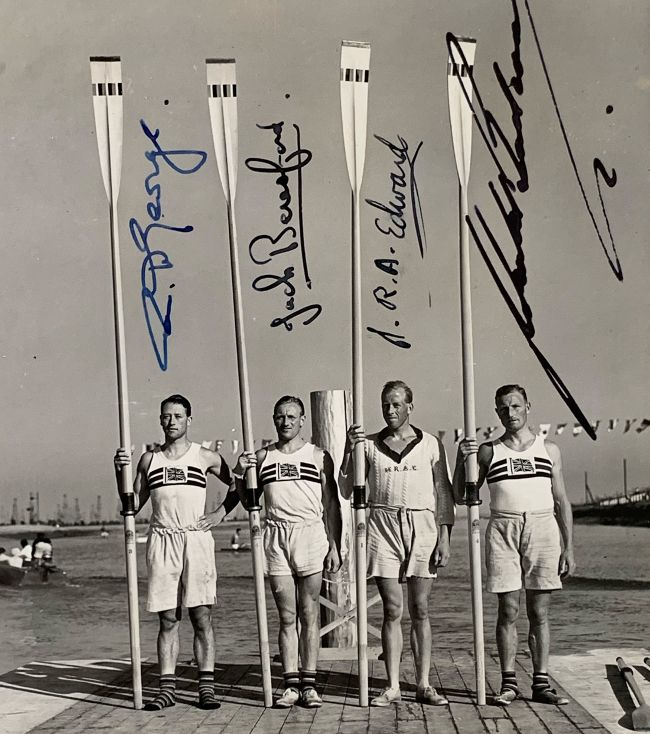
The Great Britain winning coxless four. (L-R): Rowland George, Jack Bereford, Hugh ‘Jumbo’ Edwards and John Badcock.
In 2026, the Oxford and Cambridge Boat Race celebrates the centenary of one of its most dramatic and fateful contests - the 1926 race, forever remembered for the collapse of Oxford’s Hugh Edwards. Though largely forgotten in the century since, it remains one of the most dramatic episodes in the long history of the rivalry between the Dark Blues and the Light Blues. However, a personal nadir provided the impetus for Hugh Edwards to become one of the finest, and most decorated, oarsmen in the history of British rowing.
A Bright March Morning
Saturday, 27th March 1926 dawned bright and fine, with a light southerly breeze and calm waters on the Thames. Because of the tide, that year’s race was to start early, at 12:30 p.m. By eight o’clock, spectators were already gathering in their thousands along the riverbanks, jostling for the best views. Jazz bands played, and excitement rippled through the crowd.
Newspapers were divided on who would win, though many favoured Cambridge after Oxford’s crew appeared fatigued during their final practice. Prime Minister Stanley Baldwin attended with his wife, settling into the Cambridge enclosure, pipe in hand – his loyalties clearly with the Light Blues. The atmosphere was festive, almost theatrical. As one newspaper correspondent wrote, the Thames presented a “kaleidoscopic view” of barges, launches, and huge crowds - all straining to follow the race.
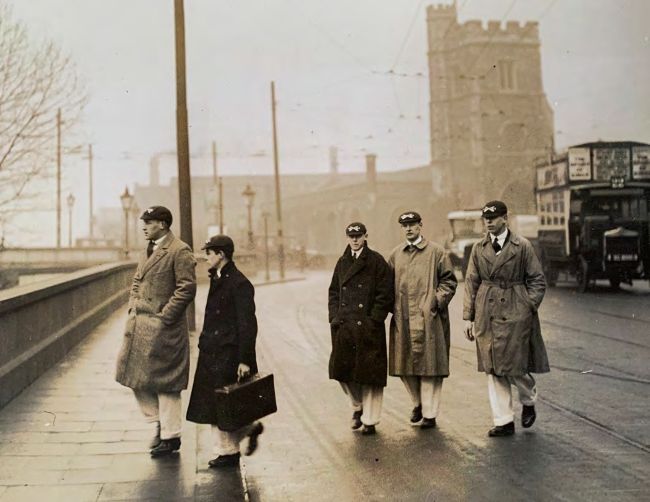
Members of the 1926 Oxford crew on Putney Bridge inspecting the race course.
The Final Preparations
In the Oxford boathouse, nerves were taut. The Dark Blues cox, Sir James Croft, later recalled the mood vividly: “It almost felt as though we were to be sacrificed, that the crowd will gloat.” Crew members performed their last checks, and Croft confessed that he secretly hoped for “a minor accident - a broken arm perhaps - that might save him from the ordeal.”
Hugh Edwards, aged nineteen and rowing at number five, remembered the daunting atmosphere as they carried the boat from the boathouse and through the crowds, past sandwich-board preachers warning, “Prepare to meet thy God.” At 110 stone, Oxford’s crew outweighed Cambridge by four stone, but it was unclear whether the extra bulk would prove an advantage. Winning the toss, Oxford chose the Surrey station, though calm conditions made the benefit negligible.
The Race Begins
At 12:26 p.m., the starter’s flag fell and a tremendous cheer erupted from the banks. Both boats leapt forward, oars biting into the water in perfect unison. Oxford quickly found their rhythm, rating 37 strokes per minute, to Cambridge’s 36. After the first minute, the Dark Blues led by a canvas length, extending this to a quarter length at the Mile Post. By Hammersmith Bridge, they were half a length ahead, rowing with power and precision.
For much of the early race, Croft steered “almost criminally well,” holding the perfect line. The factories along the river joined the spectacle, sounding their hooters in salute. The roar of the crowd built into what Croft described as “a dome of sound… like the roof of a cathedral” over the river. It was shaping into one of the closest Boat Races in years.
Neck and Neck
As the crews passed Hammersmith, both maintained a blistering pace. The Times later declared that no race since 1909 had seen such a sustained neck-and-neck battle. Oxford held their lead through the bend toward Chiswick Steps, but Cambridge’s stroke, Hamilton-Russell, called for a powerful spurt, matching every push of the Dark Blues.
At this crucial point, the Cambridge cox Justin Brown shouted across the water, accusing Oxford of encroaching: “Oxford, you are in my water! Give way, you buggers!” Croft ignored him - “the one with the best bluff wins,” he would later write - and held his line. Then, at Chiswick, everything changed.
Disaster Strikes
As Cambridge surged, Oxford’s rhythm faltered. The number six, James “Spud” Thomson, glanced around at the opposing boat - against all rowing etiquette - and over the wrong shoulder. His stroke broke the crew’s rhythm. Behind him, Hugh Edwards, already near his limit, collapsed.
From the riverbank, spectators saw the Oxford number five vanish. He had fallen backwards onto the knees of his crewmate, “Nono” Rathbone, his oar dragging uselessly in the water. Rathbone shouted for him to rise, pushing him upright, but Edwards slumped again. Cambridge seized the moment, pulling ahead by several lengths.
“Looking back, it is clear that I should never have achieved what I did had it not been for my collapse in the 1926 Boat Race.”
Within two minutes, the race was effectively over. Croft later described his crew as “a creature with a broken back.” When Hugh regained consciousness, he tried valiantly to row again, but the momentum was gone. Cambridge crossed the finish line five lengths ahead, in a time of 19 minutes and 29 seconds - a triumph born out of Oxford’s misfortune.
The Aftermath
The press descended on the boathouses. The Sunday Post quoted Cambridge’s Hamilton-Russell as saying, “We were all very glad to win - though I don’t think I want to go through it again.” Oxford’s stroke, Pitman, was apologetic and clearly trying to protect Edwards: “I am very sorry to have let the crew down.”
Hugh Edwards faced a swarm of reporters. “I felt groggy; that’s all there is to it,” he told them. “But I tried to pull as best as I could for the last mile.”
The Times was less forgiving, describing him as “a young, though not entirely inexperienced man… never made to row hard during practice, and a stone overweight.” The veteran oarsman Guy Nickalls was harsher still, claiming Hugh was burdened with “baby blubber.”
The criticism devastated him. Ordered to undergo medical tests, Hugh was told his heart was enlarged and that he must give up strenuous exercise entirely. He was, in his own words, “distraught” - his rowing career apparently over before it had truly begun.
Vindication and Olympic Success
Only one voice offered public compassion – that of Steve Fairbairn, the legendary coach. In a newspaper column, he wrote that Hugh had carried the Oxford boat for much of the race and was not to blame for the collapse. “The one person who showed kindness, if not truthfulness,” Hugh later reflected, “was Steve Fairbairn, who wrote that I had been pulling the whole boat along for the first two miles.”
Fairbairn’s words would prove prophetic. Though told never to row again, and facing humiliation on his return to Christ Church, Hugh’s passion for rowing and burning desire to prove everyone wrong drove him to unparalleled success. Under Fairbairn’s guidance and coaching at London Rowing Club, Hugh would triumph on multiple occasions at Henley. In 1931, at the age of 25, he won the Stewards, the Goblets and the Grand – the last oarsman to win all three Grand finals in one regatta.
The following year, Hugh was selected to represent Great Britain in the Los Angeles Olympics – partnering Lewis Clive in the coxless pairs. They won gold. However, Hugh was also drafted into the coxless four, replacing Thomas ‘Tig’ Tyler who had been laid low with influenza. The coxless four of Jack Beresford, John
Badstock, Rowland George and Hugh won gold. In those Olympic Games, Great Britain returned from California with four gold medals and Olympic titles. Hugh Edwards had contributed half of the total. He remains the only British rower to have won two Olympic gold medals at the one Olympic Games.
After his Olympic success, Hugh had proved all of his doubters wrong. He retired from rowing, having won two Olympic gold medals, two British Empire golds medals and six Henley titles. A triumphant redemption few could have foreseen on that fateful March afternoon in 1926.
Rowing for His Life
By 1932, Hugh had joined the RAF – his passion for racing boats on the water was replaced with the thrill of flying aeroplanes. On November 22nd, 1943, Hugh was the pilot and Wing Commander of a B-24 Consolidated Liberator, BZ819, of Coastal Command. With a crew of eight, they had just completed their mission of escorting a convoy in the North Atlantic, attacking the U-Boats which were threatening the Allied ships. The Liberator that Hugh was piloting had lost power simultaneously to three of its four engines, nose diving into the bitterly cold Atlantic from 300 feet. Hugh was the only survivor, rowing overnight to be picked up by a passing British trawler as dawn broke. Rowing had saved his life.
His love of rowing, and Oxford, never deserted him. In 1949, Hugh ‘Jumbo’ Edwards accepted the position of rowing coach for the Dark Blues and in 1959, with his son David rowing at number six, Oxford won the Boat Race – defeating Cambridge by the largest margin in 47 years.
“Looking back, it is clear that I should never have achieved what I did had it not been for my collapse in the 1926 Boat Race”.
A century later, the 1926 race continues to resonate. The collapse of Hugh Edwards in the Oxford boat was a personal tragedy that turned into redemption - it is a testament to the limits of endurance, the strength to return to the boat, and the indomitable spirit that defines The Boat Race itself. •
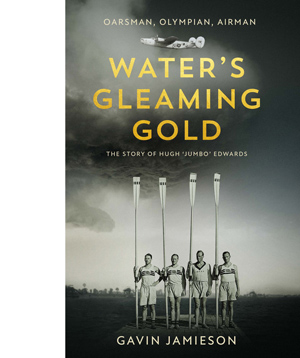
Gavin Jamieson is the author of Water’s Gleaming Gold: The Story of Hugh ‘Jumbo’ Edwards, published by Lapwing Publishing Services.