OBITUARY
Chris Dodd
A long-time and pivotal member of The Boat Race community
WORDS TIM KOCH
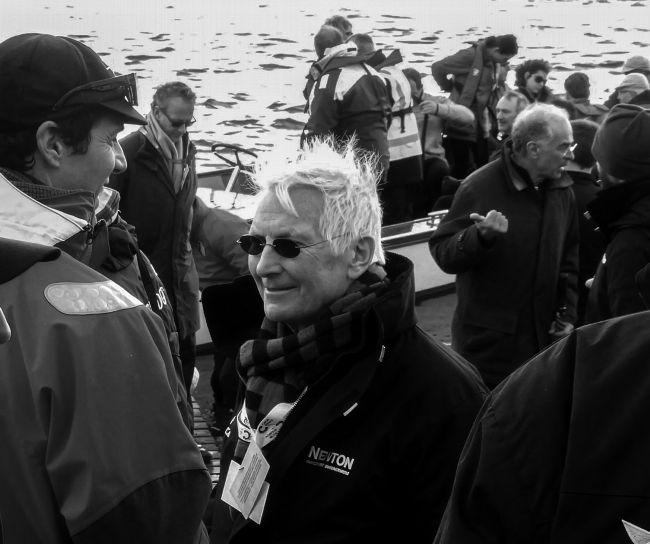
In the centre of things: Chris Dodd at the finish of The Boat Race in 2016.
O ver the last 50 years, the death of one of rowing’s most respected journalists, authors, historians and editors would have automatically called for an obituary from (depending on the era) the typewriter, word processor or laptop of Chris Dodd.
Sadly, with Chris’ passing there are few who can properly fill his place, few who can capture a full life in a deft piece of writing peppered with wry humour, telling anecdotes and quiet authority.
Christopher John Dodd was born in 1942 in Bristol, southwest England. For his secondary education he attended Bristol’s Clifton College. After beginning as a schoolboy cox, he progressed to stroke Clifton’s second eight. At Nottingham University, he swapped early mornings on the River Trent for late nights in smoke-filled rooms as editor of the student newspaper.
In 1965, Chris joined The Guardian as a sub-editor. He began writing about rowing almost accidentally when in 1970 he interviewed the new British national rowing coach from Czechoslovakia, Bohumil ‘Bob’ Janousek. In 2004, he moved to the Independent for six years. Latterly, Chris contributed to both Row360 and Hear The Boat Sing.
Chris was a prolific author. His historical books covered The Boat Race, Henley Royal Regatta, World Rowing, London Rowing Club, the Watermen’s Company and professional Tyne rowing. With John Marks, he wrote Battle of the Blues, commemorating the 150th Boat Race. Chris was also Chairman of Media for two world championships, Chief of Olympic News Service for Rowing at the Atlanta Olympics and a member of the FISA media commission from 1990 to 2002.
It was, however, Chris’ part in the founding of the River & Rowing Museum (RRM) in Henley-on-Thames that should have been his greatest legacy.
After getting the “mad project” off the ground, Chris was central to creating the rowing collection. In 2019 Chris recalled: “From the beginning, boats had to be the backbone of the museum’s collection. When construction began, we curators had the luxury of possessing no objects and the teeth-chattering challenge of creating a collection to fill our space from nothing…” An early addition was the boat used by Oxford in the first University Boat Race.
The museum won many accolades including being ranked among the world’s top 50 museums by The Times newspaper in 2013. Between 1998 and 2025, the RRM was visited by over two million people and amassed a collection of 35,000 objects.
Sadly, it was not to last. After 27 years the RRM closed for economic reasons in 2025, a cause of enormous sadness to Chris.
Chris died after a long battle with Parkinson’s Disease. I saw him two days before his death, he was frail but lucid and could remember every chapter heading of a book that he was working on. He was a writer to the end.
In his long, prolific and much lauded career, Chris wrote the obituaries of many of rowing’s departed greats – and now he has joined them. In his own writing, he understood that rowing is shaped as much by those who record it as by those who pull the oars. With Chris’ death, the sport will continue with fewer words worth reading, fewer memories properly kept, and fewer voices capable of explaining why the past matters. •
Christopher John Dodd, journalist and author, born 14 February 1942; died 25 January 2026.