HISTORY
Sandy Irvine: Hero of Oxford and Everest
A century on, Everest gives up a clue but the mystery of the missing climber and Oxford Blue persists.
WORDS TIM KOCH
Tim Koch of HearTheBoatSing.com on an Oxford Blue who died aged just 22 but whose compelling story still fascinates one hundred years later.
Since the first Oxford - Cambridge Boat Race in 1829, the crew lists have included many people who achieved great things in later life in endeavours as diverse as soldiering, business, science, sport, exploration, politics and the law.
However, few have made their post-Boat Race mark quite so immediately - or had the extent of their achievement mired in quite so much mystery - as Andrew Comyn “Sandy” Irvine, a man who suffered a tragic but heroic death just fifteen months after he won the 1923 Boat Race with Oxford.
Irvine’s story is particularly tantalising as, while it has given up some of its secrets over the 100 years, it continues to hint at the possibility of more to come.
A biography of Irvine on the website of his old Oxford college, Merton, begins:
“Sandy Irvine was born brave. From his earliest childhood… he showed no fear as he explored his surroundings with his older brother and sister. Riding a bicycle downhill with his feet on the handlebars, climbing trees or swimming in the rapids in North Wales thrilled him…”.
In 1915, Irvine went to Shrewsbury School where, except in the sciences and in practical skills such as engineering, he struggled academically. In sport however, he excelled.
“Irvine’s story is particularly tantalising as, while it has given up some of its secrets over the 100 years, it continues to hint at the possibility of more to come.”
By 1917, the 15-year-old and 73kg Irvine was rowing in the Shrewsbury First Eight with boys up to three years older. The crew’s best win was the Elsenham Cup For Schools and Colleges at the Henley Peace Regatta of 1919. The Elsenham was the Peace Regatta’s equivalent of Henley Royal Regatta’s Ladies’ Plate, the race that schoolboys entered before the Princess Elizabeth Cup was instituted in 1946.
Despite the problems resulting from what was probably dyslexia (then a rarely recognised condition) Irvine went up to Oxford in January 1922 and was soon rowing for his college, Merton, rapidly graduating into Oxford’s 1922 Boat Race crew. He had put on 6kg in weight since 1919 and The Times newspaper said, “He appears to be powerful for his age, and is evidently a hard worker…”.
The Official Boat Race Centenary History is harsh on Oxford’s performance in the 1922 Race, saying that …it was immediately evident to all that Cambridge were decidedly the better crew… The Light Blues won by four-and-a-half lengths.
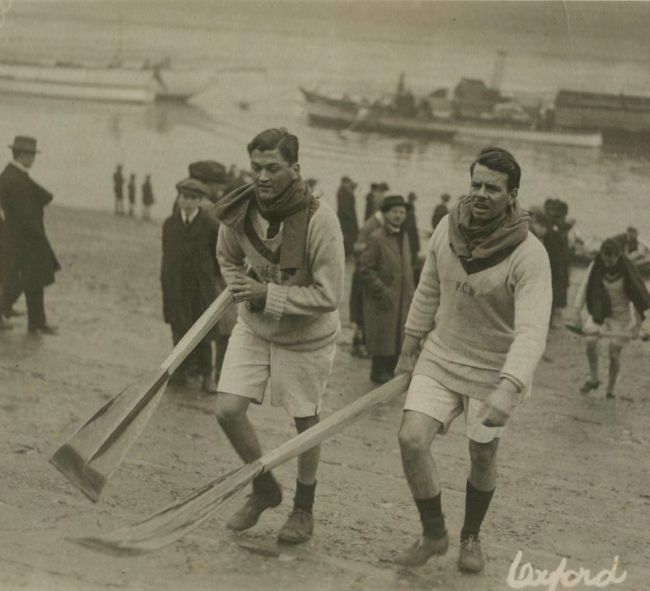
1923 Oxford Blues P. C. Mallam and W. P. Mellen carry their oars up the embankment.
Next year in the 1923 Boat Race, Oxford had a poor start but soon moved ahead and were three-quarters of a length up at Hammersmith Bridge where they began to draw clear. Cambridge fought back at Barnes Bridge but, even with the bend in their favour, they could not take the lead and Oxford won by three-quarters of a length.
Between the two World Wars, the Oxford - Cambridge Boat Races of 1920 to 1939 saw perhaps the high point of the British public’s adoration of the two competing crews. In the final weeks of training, hundreds gathered at Putney to watch and the newspapers reported on every outing and gave detailed technical analysis. Many schoolboys could name every crew member.
However, these oarsmen were not the only student heroes of the time. The inter-war period saw “imperial exploration” in the form of numerous expeditions by Oxford and Cambridge undergraduates to frozen wastes, burning deserts and dense jungles. Sarah Wheeler has written that these Oxbridge adventurers: “…came to embody the marriage of intellect and action that characterised exploration in the 1920s and 1930s. The jingoistic British public were gasping for heroes, especially since ideals had perished by the million in the First World War…”.
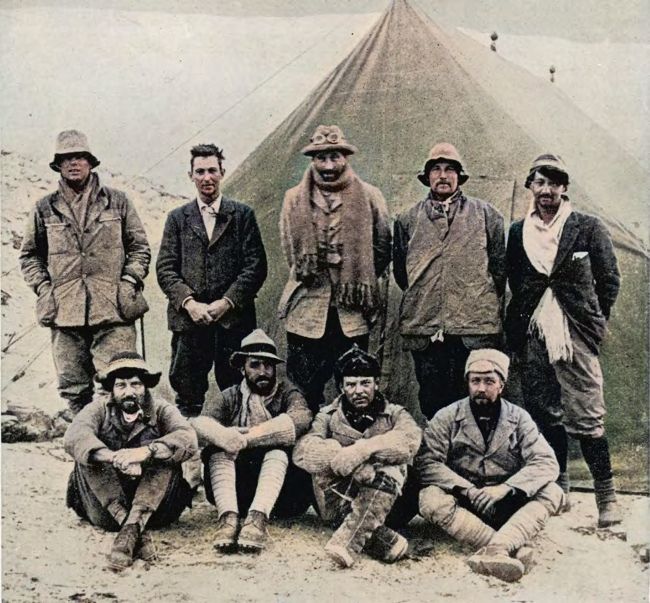
The 1924 Everest Expedition team in their camp. Irvine and Mallory are pictured left and second left of the back row respectively.
Wheeler held that exploration was, “a pure and idealistic pursuit that transcended war and economic depression”.
It was in this vein that in 1923, George Binney of Oxford’s Merton College organised an Oxford Arctic Expedition to the Norwegian island of Spitsbergen. He wanted to include a couple of rowers based on their physical stamina and their mentality of resilience and chose the Merton College First Eight’s stern pair, Blues Sandy Irvine and Geoffrey Milling. Soon after the 1923 Boat Race,
Irvine was in North Wales learning to climb mountains. He did well on the expedition itself and his Merton biography notes:
“Noel Odell, who led the Spitsbergen expedition, was impressed by Sandy Irvine’s ability to fix any piece of equipment that went wrong or broke, from ski bindings to sled runners, hurricane lamps to tent ropes. He was also encouraged by Sandy’s strength and his tough approach to cold and discomfort.”
“Discomfort” is not really a strong enough word. One seasoned climber observed phlegmatically that at high altitudes, “your feet can be suffering from frostbite while you are getting sunstroke at the same time”. Some discomforts suffered by earlier expeditions were avoided in 1924 by the adoption of more effective clothing. When the playwright George Bernard Shaw saw a picture of the 1921 Everest Expedition wearing tweed jackets, knickerbockers, puttees and felt hats, he remarked that it looked like a “Connemara picnic surprised by a snowstorm”. The most significant improvement was the adoption of Burberry made lightweight and windproof gabardine suits for the outer layer giving much better protection than tweed had done.
Despite his youth and lack of mountaineering experience, Irvine quickly built a reputation based on his athletic fitness honed through rowing, his cheerfulness under pressure, his adventurous spirit and his remarkable mechanical aptitude and knack for engineering solutions. Irvine’s ability to modify and repair the primitive and unreliable oxygen breathing equipment became invaluable.
Back at Oxford for his final year, 1924, Irvine would almost certainly have been selected for that year’s Boat Race and would probably have been chosen as the Oxford University Boat Club President. Instead, his final service to OUBC was to coach the Trial Eights crews in the last months of 1923.
Getting two terms special leave from Merton, Irvine accepted an offer from veteran mountaineer George Mallory based on his performance on the 1923 Arctic Expedition. He agreed to join a 1924 expedition to climb a mountain known as
Sagarmatha in Nepal, Chomolungma in Tibet and Mount Everest in the West. The peak stood five-and-a-half miles high (the length of the Boat Race course plus another mile-and-a-quarter) the highest point on earth.
A British attempt to climb to the top of Everest was a matter of national pride and honour. Britain had been beaten by Americans to the north pole in 1909 and by the Norwegians to the south pole in 1911. Everest was “the third pole”, the only one left to be conquered.
“Mallory and Irvine probably climbed higher than any human beings had before them.”
In early May 1924, the nine British core expedition members plus a team of thirteen elite Sherpas and 100 Tibetan and Nepali porters (carrying among other things forty-eight bottles of champagne and sixty tins of quail in foie gras) arrived at Everest Base Camp where they began the long process of carrying loads up the mountain to establish progressively higher camps.
Though not unusual for the time, the expedition did not credit its Sherpas and porters in the way that modern expeditions do. Contemporary accounts focused on the British climbers, largely ignoring the native people who played an indispensable role. Some of the 1924 Expedition Sherpas’ names that we do have appeared in a photograph together: Norbu Yishe, Lhakpa Chjedi, and Semchumbi.
By 6 June, Mallory was ready to make his final summit bid and chose Irvine as his partner for the attempt. The choice surprised some as he might have picked a more seasoned climber but Irvine clearly had qualities that Mallory valued more, not least his ability with the oxygen equipment.
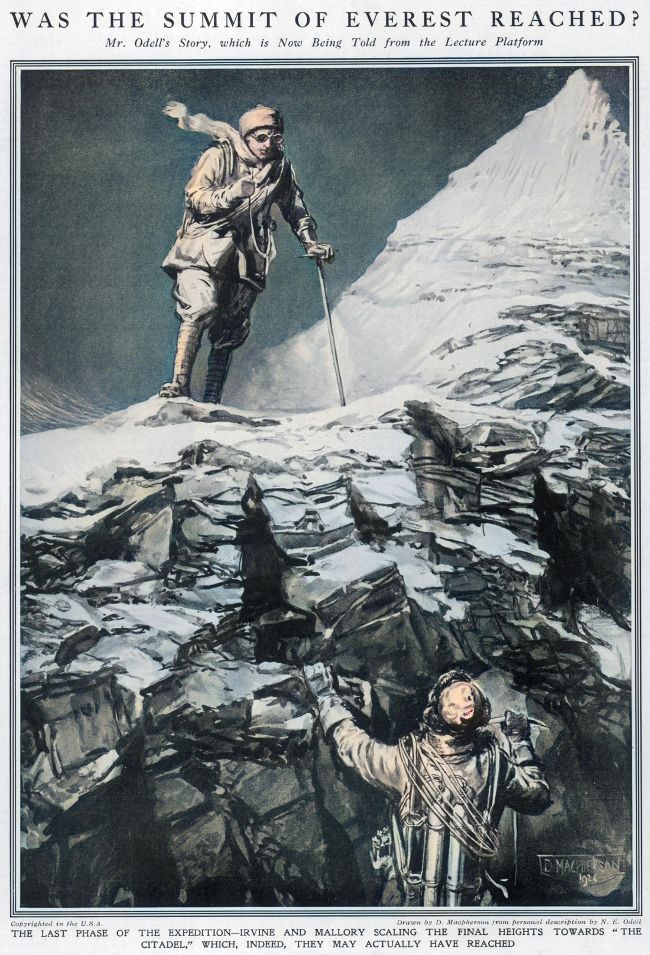
In one of the great unsolved mysteries of the twentieth century, George Mallory and Sandy Irvine were last seen alive on 8 June 1924 just 800 feet/245 metres below the peak of Everest and, according to Noel Odell who was below them and climbing in support, they were “going strongly for the top”. The two men disappeared into a cloud and were never seen again. In Britain, national mourning culminated in a memorial service at St Paul’s Cathedral attended by the King.
If they had succeeded in reaching the highest point on Earth, it would have been twenty-nine years before Edmund Hillary and Tenzing Norgay officially conquered Everest in 1953. The unanswered question remains: did Mallory and Irvine perish before or after they reached the summit?
Mallory’s remains were located in 1999, less than 600 metres from the top, and offered some clues. His snow goggles were in his pocket, suggesting that he died in the evening as the pair had been descending from the peak. Further, Mallory had planned to leave a photograph of his wife on the summit and this picture was not found on him. The position of Mallory’s body, well below where Odell believed he last saw him, could also suggest that the pair were descending when there was a fatal fall.
In 2024, a climbing boot containing a sock labeled “A.C. Irvine” and a foot were found emerging from melting ice just below the north face of the mountain by a National Geographic documentary team. To discourage trophy hunters they declined to elaborate on its exact location but essentially it was below where Mallory’s remains had been located twenty-five years earlier. The discovery of Irvine’s foot could be the first step to finding the rest of his body and perhaps the camera that many believe he had on him. If any camera film could be recovered and developed, it could provide the only definite proof that Mallory and Irvine succeeded in their goal before their tragic deaths. However, whatever did happen, Mallory and Irvine probably climbed higher than any human beings had before them. Andrew Comyn Irvine remains one of the most compelling figures in the history of twentieth-century exploration. His story combines athletic strength, technical skill and an adventurous spirit that popularly symbolised the gilded youth of his generation. His life was brief but his enigmatic legacy lives on despite - or perhaps because of - the unanswered question: Was Sandy Irvine one of two men who were the first to stand on the roof of the world? •