PROFILE
Winning The Small Battles
Meet MBA Student and Paris Olympian Esther Briz Zamorano
WORDS TOM RANSLEY
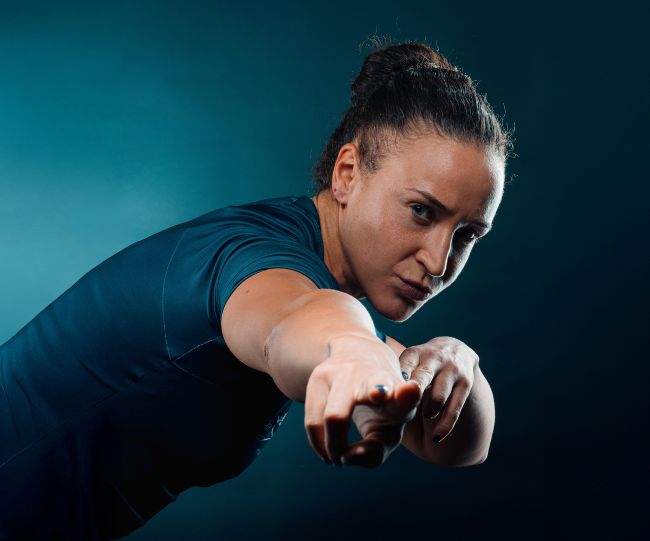
Photography: Benedict Tufnell
“Two years. If I don’t make it, at least it’s not four I’ve lost,” says Esther Briz Zamorano remembering her thoughts before she decided to become a fulltime athlete midway through the Paris Olympiad.
“I was on the young side, but it’s passion, you know? Now or never! Anyone who’s rowed at the elite level knows that’s how it is. I’m happy I did it.”
The timeframe for her current goal is tighter still. The Spanish Olympian is a key member of the 2026 Oxford Women’s squad: she believes this year will be the year Oxford turn the tide against Cambridge, and if her longshot rowing story is anything to go by, Esther-the-underdog is just what the Dark Blues need.
“It’s a big shift. Before coming here, I was racing the A-final of the world championships in Shanghai on the Sunday and by noon on the Monday I was in class. And it’s not getting better; I’ve just finished my exams today.”
“I like the expression ‘win the small battles’. If you do that then you are in a good position.”
Briz has one shot at Boat Race glory; a single season to make it count. Oxford’s latest recruit graduates from her MBA course this summer, after which she returns to Spain to chase her Olympic dream, albeit in a new discipline to the one she raced in Paris.
Having rushed from Oxford to London to join her teammates on the Tideway after a gruelling week of business exams, Briz, 26, settles herself on a gym bench beside an assortment of weights and an unloved piece of hold luggage; unloved, at least, by her Oxford teammates, but more on that later. “I hope the questions are not too hard,” she says, buzzing with post-exam energy, as we start the interview.
So why Oxford? “It’s way cooler to join the underdogs, you know? Cambridge have been winning for years, but we have a good shot. Celebrating with these people will be awesome, I can’t stop thinking about it,” says Briz. “Because of the colour too. I like the colour a lot.”
Impressed by her new teammates, the international oarswoman says there’s no paycheck to ease the early mornings and hard sessions for these student athletes. “This is not professional rowing, and yet it is so professional! These people are so committed, so passionate. It is fun to share victories together with people you care about a lot. Here at Oxford, it is the same. We have a motivated group of people fighting for something that’s important to us.”
“Nothing’s like The Boat Race,” says Briz. “The Championship Course is crazy. It is more like coastal rowing than traditional 2km flatwater racing, but it is so cool to race in these waters. I can’t wait.”
The Spanish Olympian is no stranger to bumpy water. Briz is a two-time Beach Sprint gold medallist. The wild cousin of traditional flatwater rowing, Beach Sprint rowing is a coastal rowing discipline set to make its debut at the Los Angeles Olympics, and it will be her primary focus after graduating.
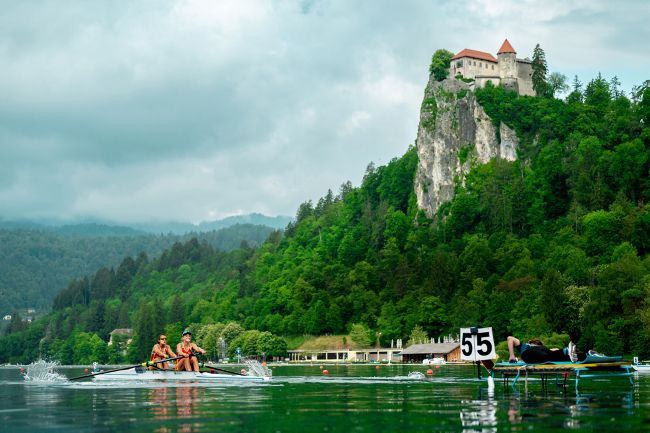
Spain’s Esther Briz Zamorano and Aina Cid I Centelles racing their pair at the 2023 European Rowing Championships in Bled, Slovenia. Photography: Benedict Tufnell
Self-belief and trusting her instincts are central to Briz’s success. “In Spain if you want to make it to the Olympics you’ve got to qualify yourself, no one else will do it for you. It is not feasible to expect someone to qualify the boat and then you get into the boat - that’s just not happening. So I had to be in Spain for that 2023 season.” Then a newly minted Stanford engineering graduate, Briz turned down job offers in the United States to pursue the pinnacle of sport.
Joining forces with two-time Olympian Aina Cid I Centelles, the Spanish duo won gold at their first international regatta together, medalled at the European championships, and then at the 2023 World Rowing Championships secured an all-important Olympic qualification spot. “There are so many things that happen in a pair and sometimes it is hard to control them all,” says Briz, reflecting on the tough Olympic year that followed.
A shot at the Paris podium eluded them. “We were upset that we didn’t make it to the A-final but winning the B-final gives you a better feeling. You leave the Olympic Village with a different feeling; some of my friends made it to the A-final and finished fifth or sixth, and they were not happy. I was lucky, I was happy after my final. It gives you a good parting memory of racing at the Olympics.”
Not many rowers win a race at the Olympics. “Yes, it is true. I won the B-final at my first world championships, and I won the B-final at my first Olympics. I won gold at my second world championships. Next Olympics…” she says with a broad smile, “we’ll see how it goes!”
Briz learnt to row in the northeast of Spain, in Zaragoza, on the Ebro River. “I love it but it is definitely not the best place to row. Conditions on the Ebro River are tough. I would say the current and the flow are strong, in those terms it is kind of similar to the Tideway but it’s shorter and narrower. My club had a one kilometre stretch to row; one kilometre of very wavey river. It isn’t super cold, but it’s usually very windy.”
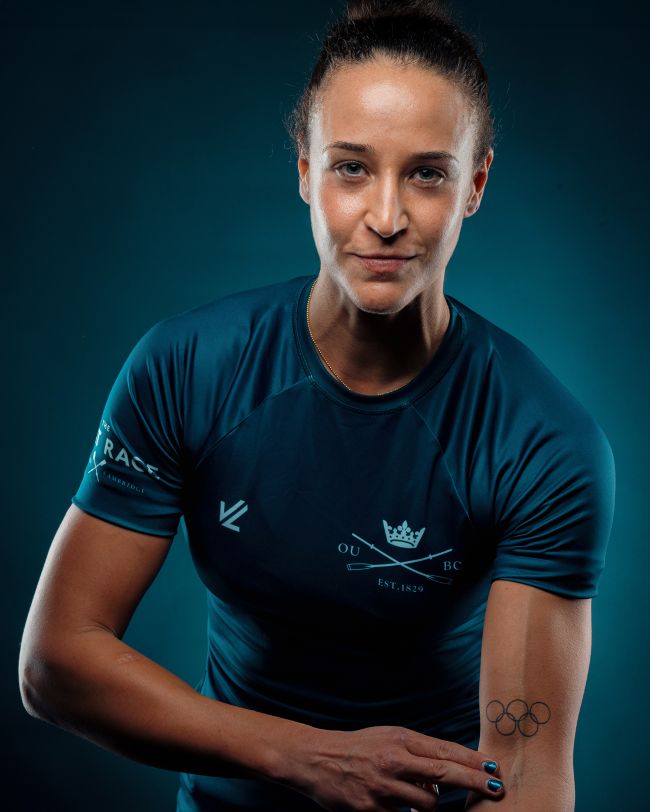
“Rowing in Spain, especially in my hometown, is not very popular, but my brother somehow got involved. ‘Esther, you should try it, it’s so fun.’ The day before starting I didn’t even know what an oar was, I knew nothing about rowing. I used to swim but rowing caught my attention because to row in Zaragoza means rowing through the middle of the city. It is cool to see the city from a different point of view.”
“I never imagined I’d go on to do the things I’ve done in the sport. I just enjoyed the motion of rowing and it was an enjoyable environment. I was surrounded by great people and great coaches. Little by little the training built and I began to feel looser in the boat.”
By 14 years old Briz was training twice a day. “The older guys started working out early in the morning before school. I joined them and I started to get faster.” Two years on Briz made her international debut. “Junior worlds were a big step up, not just rowing for Spain, but in terms of my mentality and how I saw rowing. I felt like I could do more. I could not have done what I did in 2017, without that 2016 junior world championships.”
In 2017 she won the junior women’s single sculls; only the second Spaniard ever to medal in this event, she is still the last to win it. Indeed, Briz became the first, and to date only, woman from Spain to win a gold medal at either a junior, under-23, or senior world rowing championship in the Olympic boat classes. “If someone had told me I was going to win the junior worlds in the single I’d have been like, no way!”
“Winning was the goal but it seemed impossible, especially coming from Zaragoza. There are two main rowing hubs in Spain, Banyoles in the north and Seville in the south. If you are not from those, well, they do a better job at getting people from different locations now, but back in the day it was unusual to see someone who was not from those places.”
What made the difference? “Honestly? I don’t have a good answer for that. But I do think that even if it seemed impossible a tiny part of me thought it was possible. It was something that I really wanted to do; something worth investing my time and effort in. Pure passion, I guess. My thought was that as long as I am enjoying it then I’m just going to shoot my shot and see what I can do.”
Briz brings the same approach to Oxford. “It’s unique. I’m only here for one year, so this is the year to do it all,” she says. “It’s challenging, like living two or three different lives at once. Sometimes when I study, I wonder how I’ll row; and when I row, I wonder how I’ll study!? What’s helped is my teammates, and on the academic side it’s the friends I’ve made on the MBA. It’s crazy the amount of support people give.”
Rowing for the Dark Blues has been a long-held dream of hers. Briz is set to become at least the second Spaniard to compete in The Boat Race. Her predecessor was Adriana Perez-Rotondo, who raced in Blondie (2019) and the Cambridge Blue Boat (2021 and 2022).
“I watched The Boat Race as a youngster. It was one of those goals that didn’t seem realistic, but I hope it’ll be a big milestone in my life. It seems impossible; and then you do it. Rowing at Paris, coming here to Oxford – it’s been a fascinating time in my life. There’s a lot of work behind it, but it’s paid off.”
Has the life of an Oxford Blue brought any surprises? “The amount of academic work that people do. It is not like being a professional rower. You have to combine your rowing with a rigorous academic programme and since you’re in an eight you have to coordinate nine different schedules. It is a different lifestyle; a different kind of professionalism.”
On Oxford’s ancient campus, rushing between the boathouse and the business school, surrounded by academic heavyweights, Briz admits there have been moments of self-doubt. “I’m not doing enough, those kinds of thoughts, but I like the expression ‘win the small battles’. If you do that then you are in a good position.”
An hour into our conversation and the finish line nears, but what of the elephant in the room. Briz’s suitcase. Or more specifically it’s colour: a light blue hue uncannily close to the colour of Oxford’s nemesis. Surely a controversial choice?
“No!” she protests. Then admits: “I’ve been told that a couple of times.”
From the far side of the room, lit by the luminescent glow of her laptop screen, Annie Anezakis, last year’s OUBC Women’s President, stops working. “We’ve mentioned it!” says Anezakis.
Briz bursts out laughing: “I like dark blue a lot, genuinely it’s my favourite colour but,” she raises her hands with mock-theatrically, revealing a set of perfectly manicured light blue fingernails, “this happens to be my second choice.”
“Those are light blue,” says Anezakis of Briz’s nails, “not Cambridge’s minty green!”
“Dirty green,” chimes Briz, gleefully. “Go The Dark Blues!” •
† Esther was the first Spanish single sculler to win the junior world championships, there has never been another men’s or women’s single sculling junior world champion before or since.