Profile
Head Game: Lessons from the Lionesses
England Football’s Head of Women’s Performance Psychology, Dr Kate Hays, shares high performance insights and mental game wisdom from the pitch to The Boat Race.
WORDS TOM RANSLEY
Photography: Benedict Tufnell
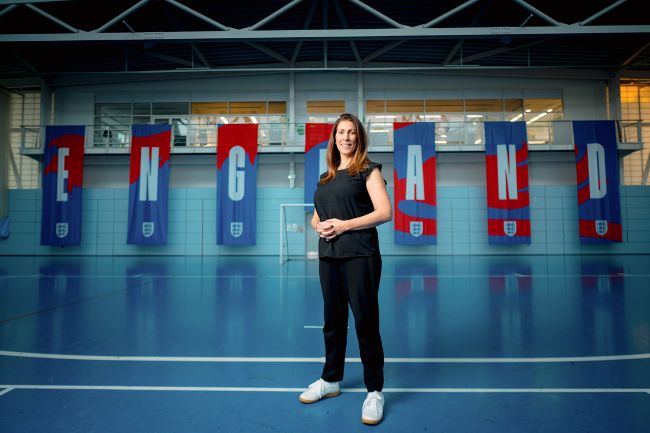
“I wanted to be the next Kelly Holmes,” says Dr Kate Hays, the Head of Women’s Performance Psychology at the Football Association (FA). Beside an immaculate training pitch at St George’s Park in Burton upon Trent, the home of England Football, Hays shares her journey from thwarted runner to renowned psychologist, her love of The Boat Race, and how marbles helped the Light Blues launch their longstanding winning streak.
For two decades Hays has worked at the sharp end of British sport, winning plaudits from the likes of Olympic champion Tom Daley and England’s women football team head coach Sarina Wiegman. She’s guided Team GB Olympians to consecutive Olympic Games and been an integral part of a staff group that helped the Lionesses reach a World Cup final and win back-to-back European Championship titles in 2022 and 2025.
Her sporting journey began on a running track south of the River Thames. “I was obsessed. I had no other plan for my life apart from wanting to be a track athlete,” says Hays, who grew up in Croydon, South London. “I used to go to the Grand Prix at Crystal Palace and watch the likes of Sally Gunnell, Colin Jackson, Linford Christie, Kriss Akabusi, Roger Black and Jonathan Edwards. It was a strong era for British Athletics.”
“The feeling of elation and euphoria comes later... You’ve almost got to love the challenge of being in physical pain.”
The dream of emulating her Olympic hero was cut short by a knee injury. “Sports science medicine then, wasn’t what it is now. The conclusion was, ‘Your knee is knackered and you’re not going to be a runner: this isn’t your calling’. I didn’t have a plan B.”
Hays scrambled to find another path. “Don’t ask me why, but from a young age two passions were ignited in me: sport and psychology. My brother happened to have some university prospectuses lying around. We’d been given them at school. I’d chucked all mine away because I wasn’t going!”
“I’ve always been fascinated by the human mind and human behaviour, and why people do the things they do?” says Hays, who remembers being enthralled by the criminal-psychology-infused plot lines of 1990s TV drama ‘Cracker’. The true crime book ‘The Jigsaw Man’ by forensic psychologist Paul Britton, was another early influence.
A decade of university study later, Hays started her career as a sports psychologist, first in diving and then with Harlequins F.C., a professional rugby club in Twickenham. “It was a big shock to the system,” says Hays of the change of sporting environments. “You don’t have four years; you’ve got a week! They play week in, week out. And there’s 50 lads in the rugby squad, so you’re not going to get far doing individual one-to-one work. It required a different way of working, which sparked my interest in a more systematic, team-level approach.”
When Cambridge came calling, she saw a chance to test these new ideas and principles. Hays was recruited ahead of the 2015 Boat Race to solve a specific challenge. For the first time in the event’s long history female rowers of Cambridge and Oxford were to achieve parity with the men by racing on the same day, on the same Championship Course, on the Tideway in front of hundreds of thousands of spectators and millions watching at home.
“It was perfect for me. I love projects and I love getting involved in something that’s never been done before. I was all in. I didn’t know what it was going to look like exactly, but the aim was to enable the rowers to do something historical and leave a legacy.”
Cambridge needed to equip their rowers with the mental toolkit to give their best on Boat Race day. “The women had never raced on that stretch of water before. It was a huge deal,” says Hays. “Oxford were juggernauts in 2015 and had an Olympic champion on board. Cambridge didn’t have anyone with experience of competing in an event of that magnitude. They needed to not be overwhelmed by the occasion.
“It wasn’t about winning or losing; it wasn’t about the result. It was about how do we give the rowers the best opportunity to recreate their best performance on Boat Race day, and in doing so achieve what’s important to them?”
The idea of uniting around a higher purpose, something that transcends winning, was, and remains, central to Hays’ approach. She calls this the North Star.
“Rowing is a brutal sport, right? Up before the crack of dawn; training in the freezing cold; studying tough subjects; working until midnight; and then doing it all again the next day. We spent a lot of time understanding what drives these rowers: their burning desire, their reason why, their North Star. We got real clarity on that. It was about challenging the status quo; leaving a legacy; and being present.”
The Cambridge women’s squad took a novel approach to fulfilling their team values. “They had two jars, each with a ribbon around it, one in the light blue of Cambridge and the other in the dark blue of Oxford. Every rower had their own marble. At the end of a training session, they’d each put their marble into one of the jars: signifying which team they had contributed to that day, either by doing the things they’d agreed to as a team, or not.”
“It’s a brilliant idea to ensure they hold themselves to account and live their values, which aren’t just words on a wall or something that looks pretty on a poster.”
Hays leans forward. “We didn’t win The Boat Race in 2015, but the rowers made history, they challenged the status quo and left a lasting legacy.” The high-performance environment that Hays had helped Cambridge create paved the way for future crews.
“There was no way I was going to walk away at that point. I wanted to go again,” says Hays, who continued with the team for two more seasons. “What got me hooked? When I started to realise what their student lives entailed. How hard they were working; how much they were prepared to commit to helping each other; and the multitude of other things they were doing beyond the boat club. It’s impossible not to be impressed.”
“Every single one of them had an unshakable work ethic and a will to succeed. They were such focused individuals. There were many personalities, but the constant was how prepared they were to do whatever it took to give themselves the best opportunity of success, particularly the presidents – unbelievable characters – they had a genuine desire to help support, lead, and be of service to the team.”
Did the idiosyncrasies of The Boat Race surprise her? “The thing that sets The Boat Race apart is that there’s no other opposition. It’s not like a football World Cup where all the other teams get knocked out before the final. It’s a two-horse race – win or lose – all the intrigue is around that; two teams pitted against each other. In that sense it didn’t surprise me because that’s exactly how you experience it on TV. The unfamiliar bits, the bits I had to learn, were all the nuances of rowing.”
“Like the start,” continues Hays. “There are a multitude of different things you must do to get away cleanly.” Coxing was another unknown. A cox is responsible for steering the boat and making in-race calls, but their contribution to the team runs deeper. “I had no understanding of how integral that role was. They are a leader in the boat. Over the course of the season, they need to get to know the athletes, learn and understand their crew, and how best to communicate with them. It’s such a significant role and as a rowing outsider you have no real understanding of how that works.”
Race day bought its own surprises. “In many other sports you don’t interact with what’s going on around you until it’s all over. You’re in your bubble doing your thing. You’re in the call room or the village away from the buzz, the excitement, and the circus of the event. But for The Boat Race you’re right in it. On the day, the rowers could still walk out amongst the fans to get their morning coffee, that almost never happens elsewhere.”
“Rowing is a brutal sport, right? Up before the crack of dawn; training in the freezing cold; studying tough subjects; working until midnight; and then doing it all again the next day. ”
Hays leant into this foible when prepping the crews. “We wanted the rowers to experience the excitement and have fun. ‘Get your civvies on and get out there. Feel what it’s like to be part of this.’ That’s a privilege because in other sports you don’t often get that opportunity.”
Rowing’s equivalent of a pitch or ring walkout comes as the rowers leave the boat sheds and walk down the embankment, parting the cheering crowds before taking to the water. The moment is marked by a theatrical flourish: the boathouse doors swing open to reveal the athletes, shell shouldered, like gladiators awaiting a watery arena.
“We spoke about that. ‘How will you respond when the doors open and you’re walking to the water?’ That was the other reason why we wanted them in their civvies, walking around on the day of the race; we wanted them to be familiar with what it looked like, and felt like, out there: an acclimatization.”
“All these things were framed as: ‘What a great opportunity!’ ‘How exciting.’ ‘Imagine telling the grandchildren.’ Never as something that was going to be hard or difficult, but always as a phenomenal thing that you get to do.”
Were there any final words of wisdom? “Rob [Baker, coach] did that. He does it brilliantly. It’s genius. He takes each rower to one side and reinforces in them why they are in the boat and what their individual strengths are. It’s very powerful. He did a lot of visualization with the crew. As is always the case, good coaches are quietly very good sport psychologists, and Rob was no exception.”
A Boat Race crowd only occurs once a year, so surely there’s a limited capacity to test drive these ways of thinking? “Yes and no. Essentially, what it comes down to is your process. In training, the coaches created lots of pressure scenarios. Is it ever going to fully replicate that event? No, but it gives you a physiological and psychological response that you learn to manage.”
“Ultimately it’s about how we function, how our brains work, and what strategies we put in place to control and optimize performance,” says Hays. “There’s a golden thread running through it, which is how humans operate and perform under pressure.”
Hays wasn’t parachuted in for race week, she witnessed the winter mileage too. “It was freezing cold. I’m there in snow boots, a hat, a thousand different layers, and a big thick waterproof coat, and then the rowers come striding out in unitards and wellington boots.”
“Rowing is hard graft. It takes a special kind of person to want to do it. In other sports, particularly in team sports like football, it’s a joy to play, but in rowing the feeling of elation and euphoria comes later, when it’s over. You’ve almost got to love the challenge of being in physical pain.”
“It’s completely different, isn’t it?” says Hays, contrasting the serenity of early mornings in Ely following the Light Blues on their Fenlands home stretch, with the madness of Boat Race day; the raucous crowds, whirling helicopters, swirling Tideway, and frenzied racing.
The Championship Course was at its most wild for the conclusion of Hays’ second year with the Light Blues. The Women’s Boat Race 2016 saw Oxford row 24-lengths clear of Cambridge, who struggled in the rough water and barely avoided sinking. “The front pages were all about Cambridge fighting to the finish and refusing to give up. How often does that happen? The losing team making headlines for all the right reasons. That’s what I mean about The Boat Race, that’s why I love it so much, there’s a real storytelling component to it.”
Hays’ time at the club was capped with a resounding win. In 2017, the Cambridge women secured their first Boat Race victory on the famous Championship Course: it was a record-breaking row and the start of their current eight-race winning streak. “It was amazing,” says Hays, remembering the celebrations. But that wasn’t what mattered most to the team psychologist.
“Every single time they delivered what they were capable of, under extreme pressure. All those Cambridge crews worked so hard and came together as a team. The rowers gain so much more from being involved in the team than from the outcome of the race. That’s the thing that’s so powerful about The Boat Race. It’s so much bigger than the result.” •