FEATURE
The Rhythms of Rowing and Watchmaking
WORDS JESSICA DIAMOND

Photography: Tom Johnson
When CHANEL announced that they were the title sponsor and timekeeping partner of The Boat Race last year with their J12 watch I lost count of the number of people who asked me about it. As a Londoner and as a watch editor, it can be argued I’m well placed to have an opinion.
I grew up in West London in the 1980s in a house right by the river in Hammersmith. From my parent’s bedroom we could see the brown waters of the Thames scudding by. It was a huge presence in our lives, flooding the nearby roads at high tide (this was pre-Thames Barrier days), offering up mud and pebbles, and driftwood, which my father collected and built our front gate from. The Boat Race was an annual highlight – we would watch from friends’ balconies or Chiswick Steps, running back up just as the surge of the wash from the boats hit. Later I would learn to row myself, at a boathouse by Barnes Bridge and I persevered for two years until I couldn’t face the early, freezing starts any longer. And then in the mid 2000s I became a watch editor, and immersed myself in the world of luxury, craft and horology, by which point CHANEL’s J12, that launched in 2000, was already an icon. Even when I first started out, I knew this watch was different. Nothing else looked like it, felt like it or embodied a knowing understanding of contemporary design in the same way. And I wanted one - because it bridged the gap between a sporty effortlessness and a serious mechanical movement.
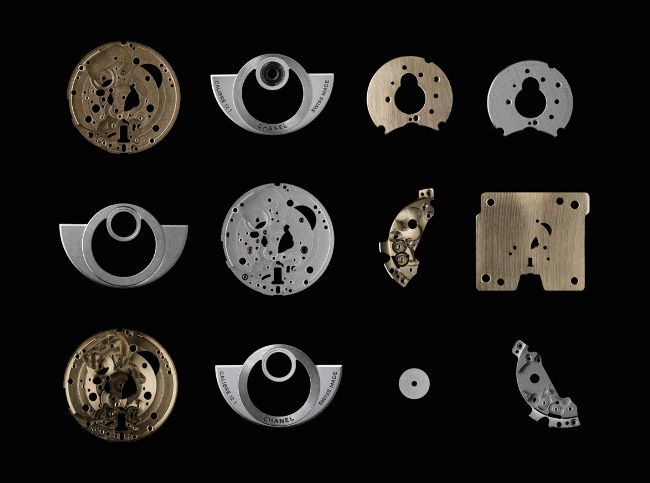
Components of the Calibre 12.1 shown at various stages of production. Photography: Thomas Cristiani
Knowing about both – the skill of rowing and the art of watchmaking - I know that both require obsessive levels of knowledge, precision, synchronicity and teamwork. But before we deep-dive into the technicalities of both, there is one fundamental, elemental similarity – water. Its connection to rowing is profound and obvious, of course. For the J12, its link comes from its creator, Jacques Helleu, then Artistic Director of the House’s Watches & Fine Jewellery and Fragrance & Beauty, who took inspiration from the yachting silhouettes of the America’s Cup racing class, the J Class, and translated them into the sleek lines of the watch’s profile, case and bracelet. Timeless, sporty, unisex and all-black it immediately caused a stir, not least because of its construction from highly resistant ceramic, the only material that could provide a perfectly monochrome result.
“One overriding ethos unites the two disciplines – a pursuit of excellence that relies on a collective effort to succeed.”
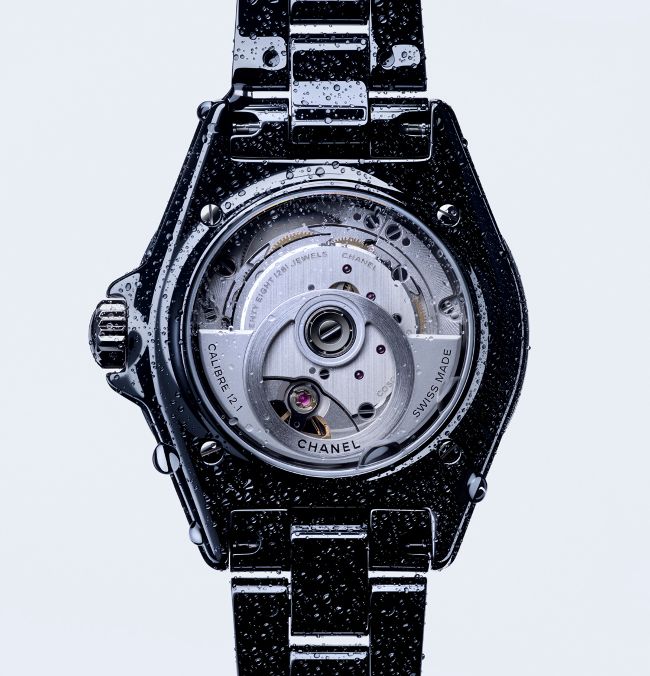
J12 as seen from the back: a perfectly circular oscillating weight and 191 meticulously assembled components reflecting the prowess of the Calibre 12.1. Photography: Haw-lin Services.
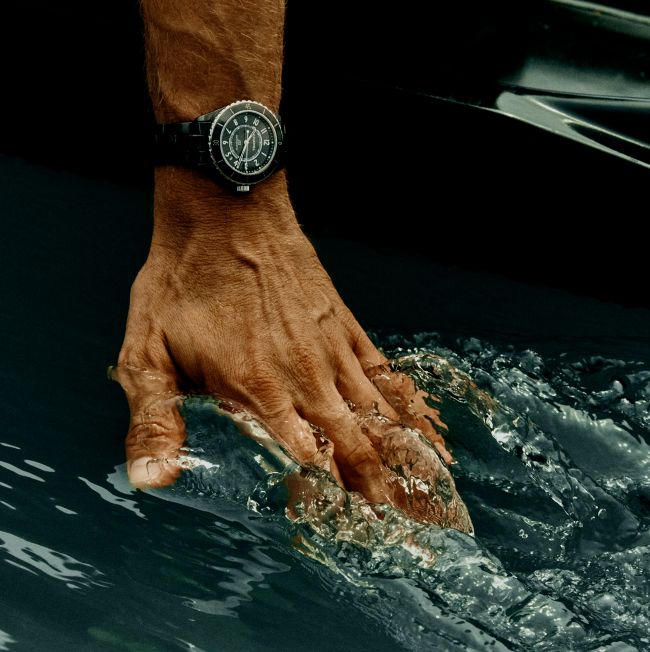
As a material it defies all reason, hugely ahead of its time in 2000, and still futuristic in its properties, 26 years later. The CHANEL Manufacture in La Chaux-de-Fonds, Switzerland, oversees the complete production process of the ceramic, heating it to over 1300 degrees Celsius, and arguably possesses unparalleled material-science expertise in this area. While seven times stronger than steel, ceramic is lighter and resistant to heat, wear, corrosion and scratching (the great nemesis of all timepieces) but also feels incredibly soft against the skin, silky to the touch, with an ergonomic, supple liquidity as it slips around the wrist. A new campaign plays on its sporty wearability with Gisele Bündchen sailing solo, a woman battling against the vicious currents – echoing the properties of this indestructible watch. In another film in the campaign, a rower sculls along a still river. Its unisex credentials are obvious while the watch’s ongoing link to water is similarly transparent.
For the Oxford and Cambridge crews that will race, timing is everything. The very thing that the J12 exists to do – mark the passage of time – is the very thing that the teams will strive to control as they race to cross the finish line before their rivals. Timing and synchronicity define a crew, elevating to winners those who can achieve perfect levels of both. “Rowing is all about synchronicity,” says Siobhan Cassidy, Chair of The Boat Race Company, “and the crew’s timing has to be spot-on”. Months, weeks and hours of technical drills and training happen in the lead-up to the race to the point that an emotional understanding exists between the crew, “a sort of magic appears with certain people in certain seats,” says Cassidy, “your aim is for the perfect eight to come together and for the perfect performance to be on the day”. The cox and each crew member will be acutely aware of the race time, of their ‘splits’ (the time it takes to cover 500 metres) and the cadence or rhythm and frequency of strokes. “In training there will be a constant flow of numbers coming towards them from their coach,” says Cassidy. “But what’s amazing is that the best crews seem to be able to create ‘extra time’. They look relaxed as if they have all the time in the world to finish first. Creating that ‘time in space’ is the outcome of doing everything very well.”
Photography: Jack Davison
Harnessing and measuring time has been the raison d’être of the CHANEL Watch Manufacture since 1993. Today the J12 38mm beats to the rhythm of the Calibre 12.1, a self-winding movement produced and assembled at the Kenissi Manufacture in Switzerland co-owned by CHANEL since 2019. Every part of the movement – all 191 components – are designed to work in tandem and harmony with each other. Proportions are everything and the components are meticulously positioned and assembled with extreme care within the confines of the case – no mean feat when individual screws are barely visible to the human eye. Chronometer-certified by COSC (a rigorous independent body that tests accuracy and precision), Calibre 12.1 guarantees a generous power-reserve of 70 hours (the amount of time a watch will run without being powered by the wearer’s movement). The finished watch including the case and strap etc. will be made up of a total of 321 parts – all working together in a feat of micro-engineering, providing the wearer with the perfect horological outcome.
It’s not unlike the component parts of a boat, crew and wider support team. On a macro level each team of eight plus cox is assisted and helped by a chief coach, assistant coaches, a psychologist, physiotherapist and nutritionist. On a more micro level each rower must play their part for the greater good. Just like the cogs and wheels of the inner workings of a watch each team member becomes a cog in the machine that is the boat, powering the movement of it through the water using human energy, just as the J12 is powered by the movement and energy of the wearer. “Rowing is a biomechanical sport,” says Cassidy, “it’s a sport of angles and levers, whether human angles and levers or whether with the boat and the hull and oars. The coaches are constantly fiddling with the setup with spirit levels and tape measures, constantly changing the angles of the crew. To row perfectly you need identical angles on all eight blades. It’s absolutely critical over such a long course, you can’t get away with it, and over a 20-minute race you’ll quickly get found out if it’s not precise”.
“The skill of rowing and the art of watchmaking. Both require obsessive levels of knowledge, precision, synchronicity and teamwork.”
CHANEL has evolved and tweaked the J12 over the course of 26 years. From the first all-black version in 2000 an all-white version followed in 2003 with the latest iteration of blue ceramic arriving last year. Chronographs, GMTs, Moonphases and Flying Tourbillons have all graced its design and it’s an ever-evolving canvas for technical knowledge, creativity and know-how. As a timepiece it doesn’t sit still – it has a life of its own in a way, never static, always moving on to something new, surprising and innovative. Racing and rowing are similarly forward thinking – there is no one formula or crew that can be replicated year after year – techniques must be observed but executions will vary according to the make-up of the team. Technology moves everything on, assisting the teams with physiological analysis, blood markers, measures of lactic acid and advancement in video analysis, for starters.
With all the similarities one overriding ethos unites the two disciplines – an uncompromising pursuit of excellence that relies on a collective effort to succeed. Just as Oxford and Cambridge develop and showcase the best of the best on the water, so CHANEL J12 supports outstanding creative expertise. With such shared goals and common ground (or should that be water) it feels totally natural and fitting that the partnership exists. And while the finish line will come first for one team on Saturday 4 April, the race for ongoing excellence for the J12 and The Boat Race will continue, stretching forwards in time. •